AI is killing the software industry
.summary {AI is the best development tool in years, and it's quietly cutting the bottom rung off the ladder that trains new developers.
} .category {Technical
} }Both these are true:
- AI is killing the software industry
- I use AI for software development every day.
I use AI to write code every day. It writes code faster than I can, doesn't make the mistakes that I do, and it gets a first draft of something working in the time it used to take me to open the right files. As a tool, it's the best thing to land in this industry since version control. At the same time, it's quietly gutting the profession I've spent twenty-five years in.
Where it's genuinely brilliant
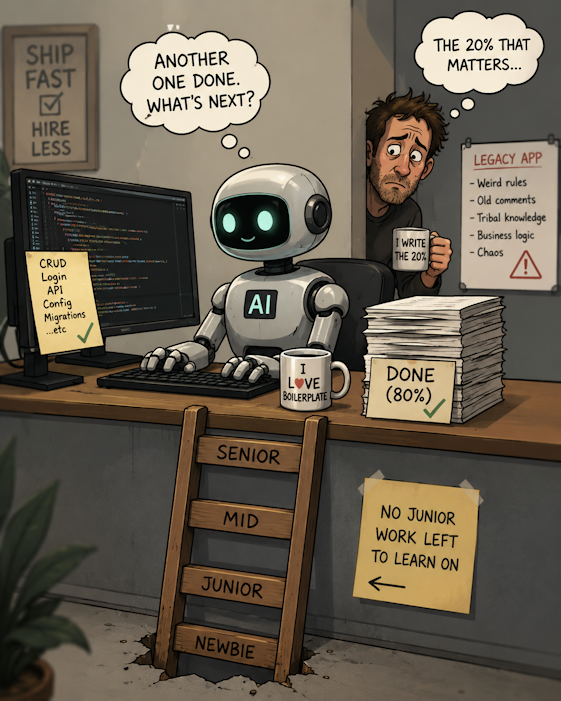
The boring stuff is where AI earns its keep. CRUD, migrations, config, forms — it does all of it without complaint and mostly without mistakes. It's also lowered the barrier to just starting. Someone with an idea and no formal training can now get something working on their own machine in an afternoon. That used to take months.
As someone who's taught people to code, this changes what's worth teaching first. Syntax was always the easy bit anyway — the hard bit was always judgement, structure, knowing why you'd choose one approach over another. AI hasn't touched that part. If anything it's made it more obvious how much of the job was never really about typing code at all.
Where it quietly falls apart
The trouble starts the moment you're not writing something new, but working inside someone else's mess. An old codebase with competing conventions and a business rule buried in a comment from someone who left in 2019. AI will confidently produce code that compiles and looks plausible. Whether it's right for that particular mess, in that particular business, is a different question entirely — and it's the question a competent developer is actually being paid to answer.
That's the bit that gets lost. AI can produce code. It doesn't yet reliably know when the code is wrong for reasons that have nothing to do with syntax.
The bit that actually worries me
Teams are being told to do more with fewer people. "AI can do that now" used as a perfectly reasonable-sounding reason not to hire, or replace someone. Every individual decision makes sense on its own. A team that can offload the boring 80% to AI genuinely doesn't need as many pairs of hands doing that 80%.
But that 80% was always where junior developers learned the job. Nobody starts out able to make the judgement calls — you get there by spending years doing the unglamorous work, making mistakes on code nobody important is depending on yet, and gradually earning the trust to touch the stuff that matters. Take away the unglamorous work and you haven't just cut a bit of cost. You've cut the bottom rung off the ladder that trains everyone who comes after.
I've written before about the gap between finishing a course and actually being employable. That gap was already wider than anyone wanted to admit. AI hasn't closed it. If anything it's narrowed the door at the bottom while leaving the gap exactly where it was.
So where does that leave us
I don't think AI is evil, and I don't think it's fine. I think the industry has built an extraordinary tool and is currently using it to eat its own future talent pipeline, without much of a plan for what replaces that pipeline in ten years' time. Somebody still needs to become the senior developer who knows when the AI-generated code is wrong. I'm just not sure where that person is meant to come from, if nobody's willing to hire and train them today.
AI is the best tool I've ever used.
It's also quietly kicking away the ladder I climbed to get here.
Page updated: 2026-09-30