The gap between
.summary {You've got the licence. You haven't got the miles - on the gap between finishing a course and being job-ready.
} .category {Technical
} }The gap is huge
I've taught a lot of people to code. PHP, MySQL, the basics of putting a working site together. Most of them leave able to build something — a form that saves to a database, a login page, a little CRUD app. That feels like a huge achievement, and it is.
Then they go looking for a job, and the gap between "I can build this" and "someone will pay me to build things" turns out to be much wider than the course made it look. Nobody sets out to hide this from you. It's just very hard to see until you're standing in it.
Companies want experience
Every junior developer job I've ever seen asks for experience. Sometimes it's dressed up — "familiarity with", "exposure to" — but it's the same ask. They want someone who has already made the mistakes, on someone else's codebase, ideally not this one.
It's not unreasonable. A company hiring a developer isn't just buying code, it's buying judgement — knowing when to ask a question, knowing what "done" actually means, knowing how to read someone else's mess without panicking. None of that shows up on a course certificate.
A PHP course is NOT experience
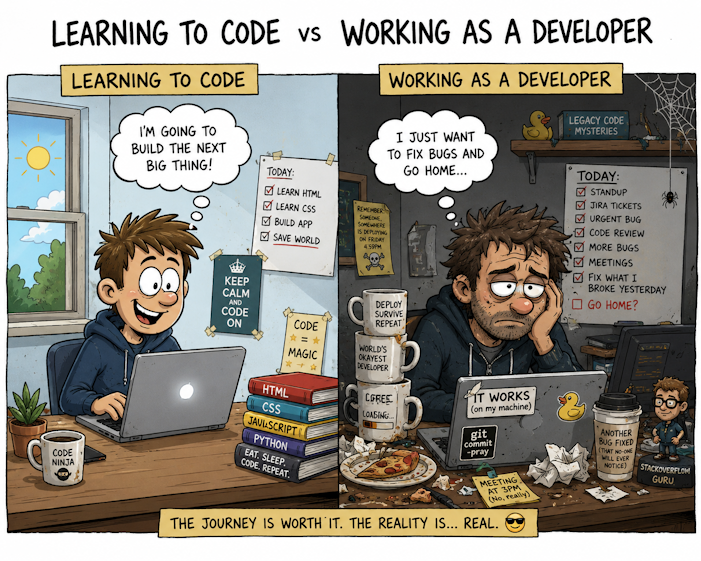
This is the bit people don't want to hear. A course teaches you syntax and concepts in a clean, controlled environment, built specifically so you can learn. A real job hands you a half-documented legacy system, three competing priorities, and a deadline from someone who has never written a line of code.
I'm not saying courses are pointless — you need the fundamentals before anything else makes sense. But finishing a course and calling it "experience" on a CV is a bit like passing your driving test and calling yourself experienced on the motorway in rush hour, in the rain. You've got the licence. You haven't got the miles.
"Good" is relative
Students ask me, constantly, "am I good enough yet?" — and the honest answer is that "good" depends entirely on what you're being compared to. Good enough to build a working app on your own machine? Probably, quite quickly. Good enough to be trusted with production code that real people depend on? That's a different bar, and it moves depending on the company, the team, and what they're actually hiring for.
There's no single finish line called "good developer" that you cross once. There's just "good enough for this job, at this company, right now" — and that's worth remembering when you're comparing yourself to everyone else on LinkedIn.
You've got the licence. You haven't got the miles.
A course teaches you to drive in a quiet car park.
A job is the motorway at night, in the rain.
Page updated: 2026-09-29